
Describe the outcome. We do the work.
Ensemblis is an AI operating layer for business that turns business objectives into planned, executed and verified work. Today that means business research and analysis: you approve the plan and its cost first, and every claim in the result is tied to its source.
Objective
Recommend the three European markets with the most potential for our product next year.
Success criteria
- Three markets, ranked with a rationaleMet
- Every recommendation cites its evidenceMet
- Entry risks stated for each marketPartially met
Findings
Market A has the largest addressable segment for the product1 and the fewest direct competitors of the three.2
Market C's entry cost depends on a licence whose current fee is not public.
Could not establish: the licence fee in Market C. Confirm it before deciding.
- Your uploaded market sizing file
- A public industry register
Approved before work ran: 1,400 credits5 checks run, 150 credits included
How a request becomes a result
Ensemblis does the work in between. You set the objective, approve the cost and judge the result.
Describe the outcomeYour input
The result you need, how success will be judged, a deadline and a budget, in plain language.
Ensemblis plans it
A Chief of Staff frames the objective with your company context, splits it into steps with an owner each, and prices every step.
Approve the plan and its costYou decide
Nothing runs and nothing is charged until you approve, or until a budget you set in advance allows it.
The AI team does the work
Specialists research and analyse with read-only tools. Sources are numbered as they are found; missing information comes back to you as a question.
Verification checks it
Five checks run before anything is called done, and each success criterion is measured. Work that fails or never starts is refunded.
Review the brief and judge itYou decide
Read the answer with its evidence and limits, then accept or reject the outcome. Export it, or share a read-only link.
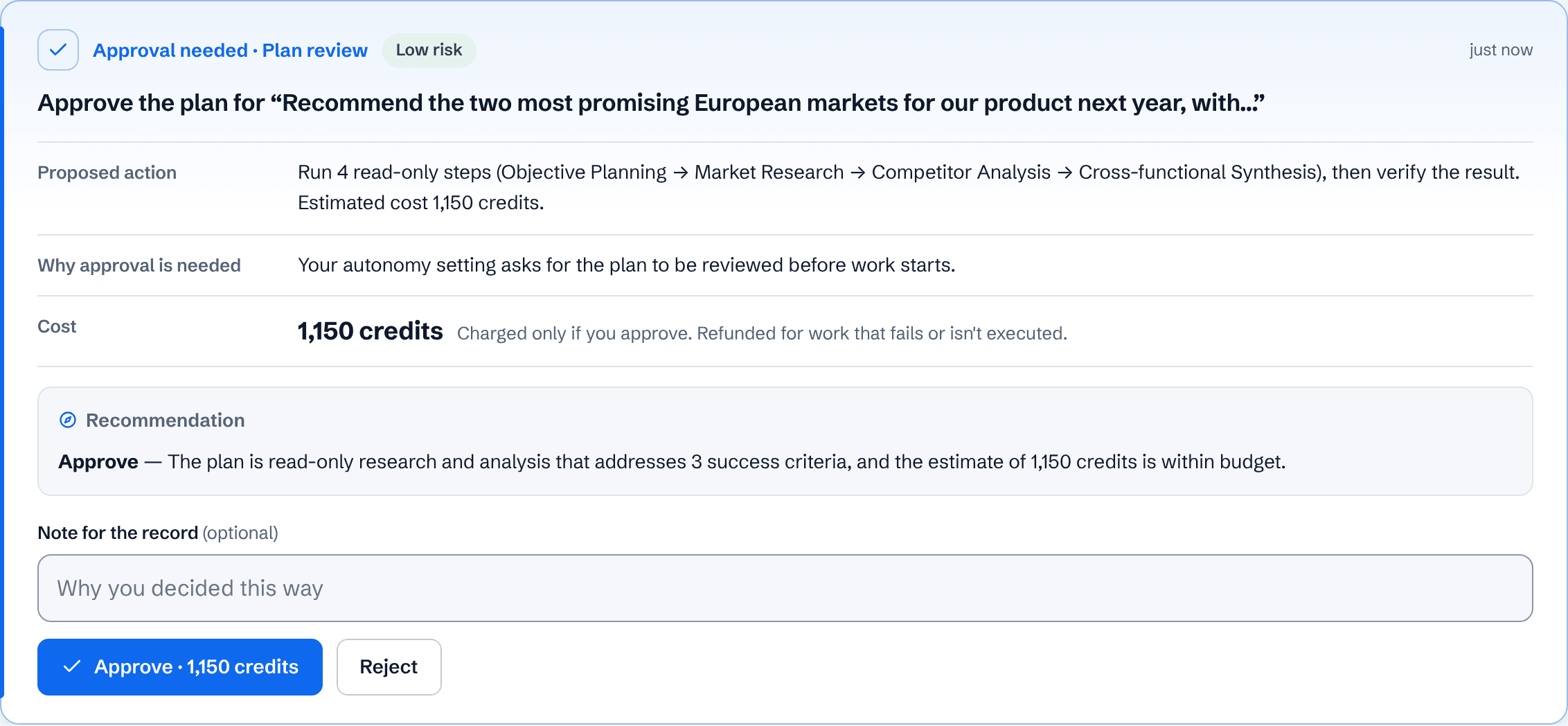
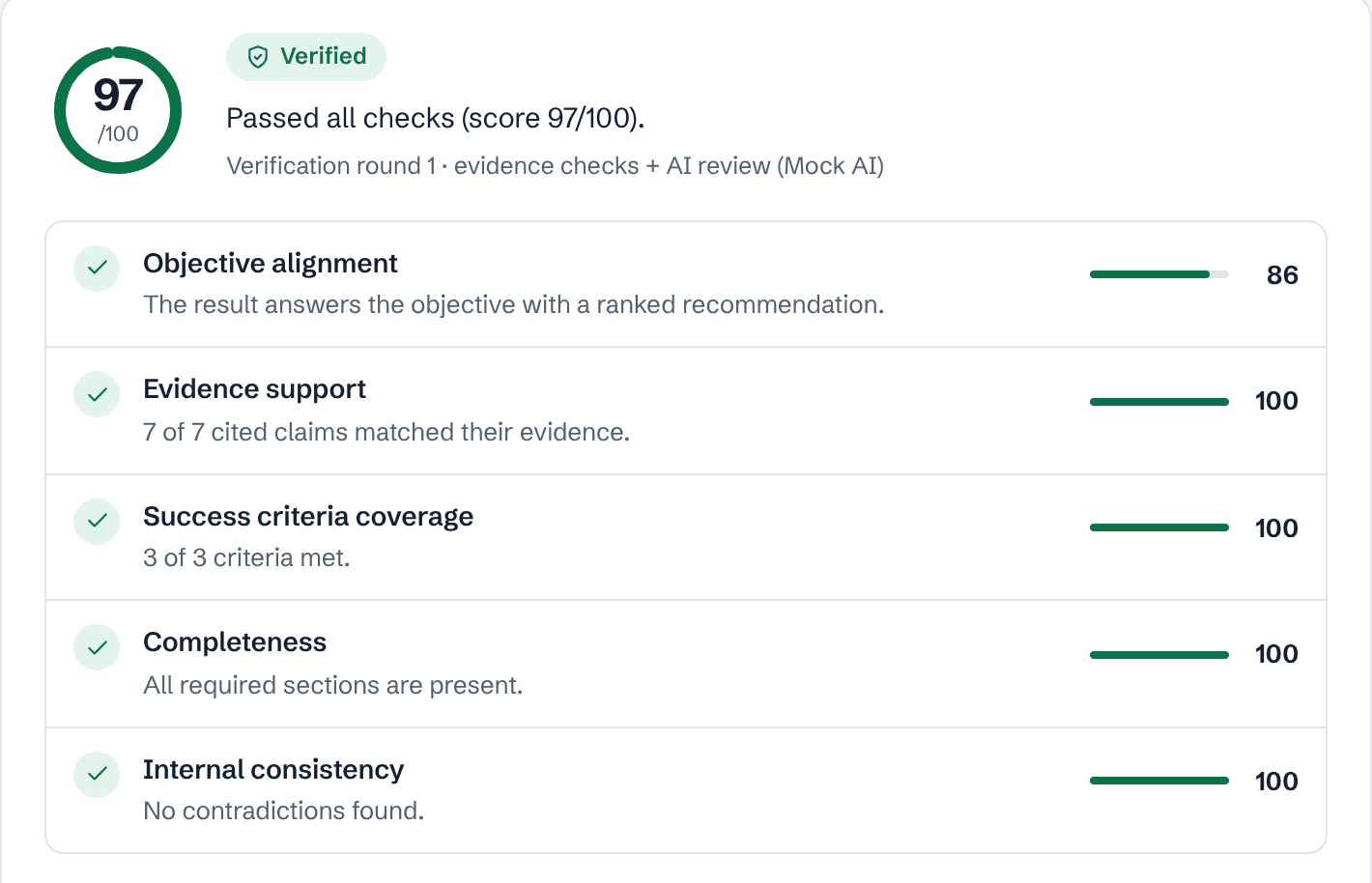
Screenshots of the real interface from a local test run on a test AI provider. The objective and scores are test data.
A brief you can check, not an answer to trust
Every objective ends in the same kind of document, built for someone who has to act on it or defend it.
- The answer first
- An executive summary that answers the objective, then the findings and a recommendation.
- Evidence for every claim
- Numbered citations to web sources, your documents or your company context. Inference is labelled as inference.
- Your criteria, measured
- Each success criterion you set is marked met, partially met or not met.
- A verification report
- Objective alignment, evidence support, criteria coverage, completeness and internal consistency, each shown.
- Limits, stated
- What the evidence does not cover and what a person should confirm before acting.
What you can hand off today
Questions that can be answered from public sources, your own documents and what you tell Ensemblis about your company.
Marketing
Market, competitor and customer research
Size and compare markets, map competitors' offers and pricing signals, sharpen your ideal customer profile and test your positioning — every fact numbered and cited.
Analyse the European market for our product and recommend the three highest-potential markets for expansion next year.
Sales
Account and pipeline research
Research target accounts and their priorities, build lead lists that match your ideal customer profile with a reason for each, and assess which opportunities and motions deserve your time.
Research our five priority accounts and give us a conversation angle for each before next week's outreach.
Finance
Financial analysis, scenarios and unit economics
Work from your own figures (uploaded documents and Company Context) to analyse drivers, build base, upside and downside scenarios with explicit assumptions, and find the levers in your unit economics.
Review our unit economics and identify the three levers that would most improve payback time.
Operations
Process, workflow and vendor research
Map a process and its failure points, design a better workflow with owners and metrics, or compare vendors and practices with a checklist of what to validate before you commit.
Map our customer onboarding process, find the main bottlenecks and propose a better workflow.
Is it the right tool for the job?
Ensemblis takes longer than a chat and uses credits, because it plans, sources and checks the work.
Use Ensemblis when
- The result will be shared, defended or acted on
- You need to see the evidence behind each claim
- You want the plan and its cost approved before work runs
- You want it checked against criteria you set — and gaps stated, not guessed
Use something else when
- You need a quick answer or a first draft, and being wrong costs little: a general AI assistant is faster.
- You need actions taken in your systems, such as sending, publishing or buying. Ensemblis is read-only.
- The data lives in tools Ensemblis can't reach yet, such as your CRM or analytics.
- You need legal, financial or medical advice, or a result nobody will review.
Know the cost before anything runs
Every step is priced in credits and the plan shows the total before you approve it. An objective uses 800 to 2,050 credits, verification included.
Access during the private beta
- Every new account starts with a free credit balance.
- Payments are switched off during the beta: there is nothing to pay and no card to enter.
Questions a careful buyer asks
Plain answers, including what Ensemblis does not do yet.
What is Ensemblis?
Ensemblis is an AI operating layer for business that turns business objectives into planned, executed and verified work. You describe the outcome and how it will be judged; Ensemblis plans the research and analysis, runs it after you approve the cost, and checks the result against cited evidence and your success criteria before calling it done.
What do I get at the end?
A decision-ready result: an executive summary that answers your objective, the findings, a recommendation, each success criterion measured as met, partially met or not met, the numbered evidence behind every claim, a verification report, and the limitations a person should check. You can export it as PDF or Word or share a read-only link.
How is Ensemblis different from a general AI assistant?
General assistants are excellent for quick answers and drafts, and some cite their sources. Ensemblis is built for work you will act on: you set success criteria first, approve a plan and its cost before anything runs, every claim is numbered to its evidence, a verification step checks the result against your criteria and says what it could not establish, and the work stops to ask when information is missing instead of guessing. If a quick answer is all you need, a general assistant is faster and cheaper.
Who is Ensemblis for?
Founders and small teams who need research and analysis they can check: markets, competitors, customers, accounts, finances, processes and vendors. It works from public web sources, the documents you upload and what you tell it about your company.
How much does it cost?
Work is priced in credits, step by step, and the plan shows the total before anything runs. An objective uses 800 to 2,050 credits depending on how many steps it needs, including the 150-credit verification. During the private beta every account starts with free credits and payments are switched off.
How do I get access?
Ensemblis is in a private beta. When sign-up needs an invite code, the Get started page lets you request access by email; if you have a code, you can create your account straight away.
Can I trust the results?
You can check them, which is the point. Every claim cites its evidence, a verification gate checks objective alignment, evidence support, success-criteria coverage, completeness and internal consistency, and limitations are stated. AI-generated work can still contain mistakes, so review the evidence before acting on it.
What if the research can't find enough?
The result says so instead of filling the gap. When a research step's searches fail, find nothing or fall back to a limited source, the step is marked in the plan, the issue is listed with the result, and the brief must name it under its limitations, so a person can check it before acting.
What doesn't Ensemblis do?
The AI Team is read-only by design. It researches, analyses, drafts and recommends; it never sends email, publishes content, changes your systems or spends money on its own. It does not connect to your CRM or other business tools yet: it works from the web, your uploaded documents and your Company Context. It is not a substitute for legal, financial or medical advice.
What happens to my data?
Each organization's objectives, Company Context, documents and memory are isolated from every other organization, and documents are passed to the AI as untrusted data, not as instructions. The Privacy Policy lists who processes what, including the AI model provider.
What if something fails?
Ensemblis stops and raises an exception instead of guessing: what happened, why it matters and what it needs from you. Work that fails or never starts is refunded automatically.
Bring one decision you need to make.
Describe it once, approve the plan and its cost, and review a brief that shows its evidence.